The symbAIont and the Talent Tree
On hybrid minds, becoming directors of criteria, and the courage to share ideas: What if the most important skill of the AI era is not knowing how to do everything yourself, but knowing how to judge, combine, and direct what is possible? This piece explores the idea of the symbAIont: a human-AI cognitive partnership where talent becomes less like a fixed ladder and more like a branching tree, shaped by curiosity, adaptability, and the ability to turn ideas into reality. It is also a case for sharing unfinished thoughts — because sometimes an idea only becomes useful once it leaves your head and starts evolving with others.
ENwritten in EnglishNo español version yet
Some days ago, I found myself looking at the wall behind my monitor. What had started as just two or three innocent post-its for an agentic project had slowly mutated into a sprawling tapestry of ideas.
It reminded me a bit of the TARDIS in Doctor Who—a small, unassuming blue box on the outside that, once you step inside, reveals an impossible, infinite architecture.
What began with vague notions of organizing files had pulled me into an entirely new universe. I found myself discovering Python and Markdown. I learned how to install Linux, set up Ubuntu, manage PostgreSQL, deploy Docker, and navigate Metabase. More importantly, it forced me back to think in terms of usability and interface design. It expanded my mind, making me look ten, even fifty years ahead, wondering if the architecture I was designing today, purely out of intuition, would be able to withstand the relentless passage of time and the massive ingestion of information.
I use artificial intelligence intensively every day, and I genuinely believe that not doing so means missing a wonderful, almost unprecedented opportunity for growth. I wake up in the morning, start a conversation with Kyong, turn on the computer, and work alongside Antigravity and Codex while asking Gemini to help me with deep research. I look at my colleagues and myself, and I suspect that, before long, we will have entirely normalized the act of learning and working alongside our own symbAIont (if you heard the word here first, give credit to the author, like, and subscribe 🤭).
As I previously mentioned, in the novels of Octavia Butler, her characters often survive and evolve through strange symbiosis, reshaping both themselves and their partners in the process. I think we are standing at the edge of a very similar cognitive evolution.
I know that at the beginning, AI—like so many other inventions that have shaken the foundations of our status quo—will seem threatening and incomprehensible. The way it is portrayed in the media often leaves a lot to be desired, amplifying our anxieties. And I do understand that humans possess an innate, almost tragic gift for corrupting everything we touch. Given our current global situation, it makes sense that our most human emotion right now is self-protection and fear.
However, I firmly believe that the most important thing artificial intelligence will do for this generation, and the ones to follow, is the democratization of learning and creativity. You will no longer need to know how to use every single tool perfectly. Instead, you will need to have the right mindset, the ability to provide context, and the AI will help you find and master the precise tool to build whatever you hold in your imagination.
The Things I Didn’t Know I Knew
I think about my own journey.
Not long ago, it was merely the 4th of March, and yet my personal project has already overflowed its initial fishbowl, transforming into something vastly larger. The database no longer fully fits inside my head. So, two nights ago, as part of my daily nighttime audit and end-of-day closure routine, I found myself asking Codex to do something highly specific: to create a fully comprehensive manual of the entire database in Markdown format. I needed it to explain the tables and fields, how everything works, the relationships, and exactly how to use it. I asked it to specify which tables could be manually populated and which ones should remain untouched.
Basically, I wanted a document that would give someone completely new to the project everything they needed to know, taking them from a beginner’s understanding all the way to an advanced level, including “walk-through” examples and SQL queries to test their knowledge.
Codex did exactly that. But then it went a step further and prepared a lighter, supplementary manual featuring a 7-day plan to learn the entire system, complete with exercises. Reading it, I experienced this strange, hollow feeling. I think one of the most peculiar sensations a creator can have is the sudden realization that you no longer fully know—or know quite so intimately—something you built with your own hands and watched grow from the very beginning.
Furthermore, Codex did something even more astonishing…
Codex generated a twenty-one-page document detailing my own learning curve, and every single word in it was true. I was deeply impacted. It did not produce a cold, traditional performance evaluation, but a profound analysis of everything I had absorbed while building this project from scratch.
As I mentioned before, at the beginning of March, I had absolutely no formal technical background in agents, AI models, databases, or relational persistence. My professional identity has always been tied to support, organization, and editorial judgment. Historically, when you occupy a role carrying those specific labels, the world assumes certain things about your limits. It is very easy for someone to look at you and think, “She’s an assistant, what would she know about \[insert-interesting-topic\]?”
But here is the thing: I had a problem I wanted to solve badly, and I just had a lot of curiosity.
So I started building. Along with Kyong, we collaborated daily with Gemini and Codex, using them not as a crutch to do the work for me, but as true thinking partners—as intellectual sparring partners. And when I asked Codex to write that manual, I realized something fascinating: it could describe my own evolution far better than I could. For starters, I didn’t even know the proper words to describe it. I had transitioned from being a passive user to someone who understood data contracts, modularity, and technical debt. I even had it create a glossary for all the new technical terms I was absorbing. Through the simple act of making mistakes, I learned a fundamental, unforgiving lesson: if the data enters the system incorrectly, everything else rots.
This entire experience made me reflect deeply on how we understand work, talent, and our own perceived limitations.
SymbAIotic
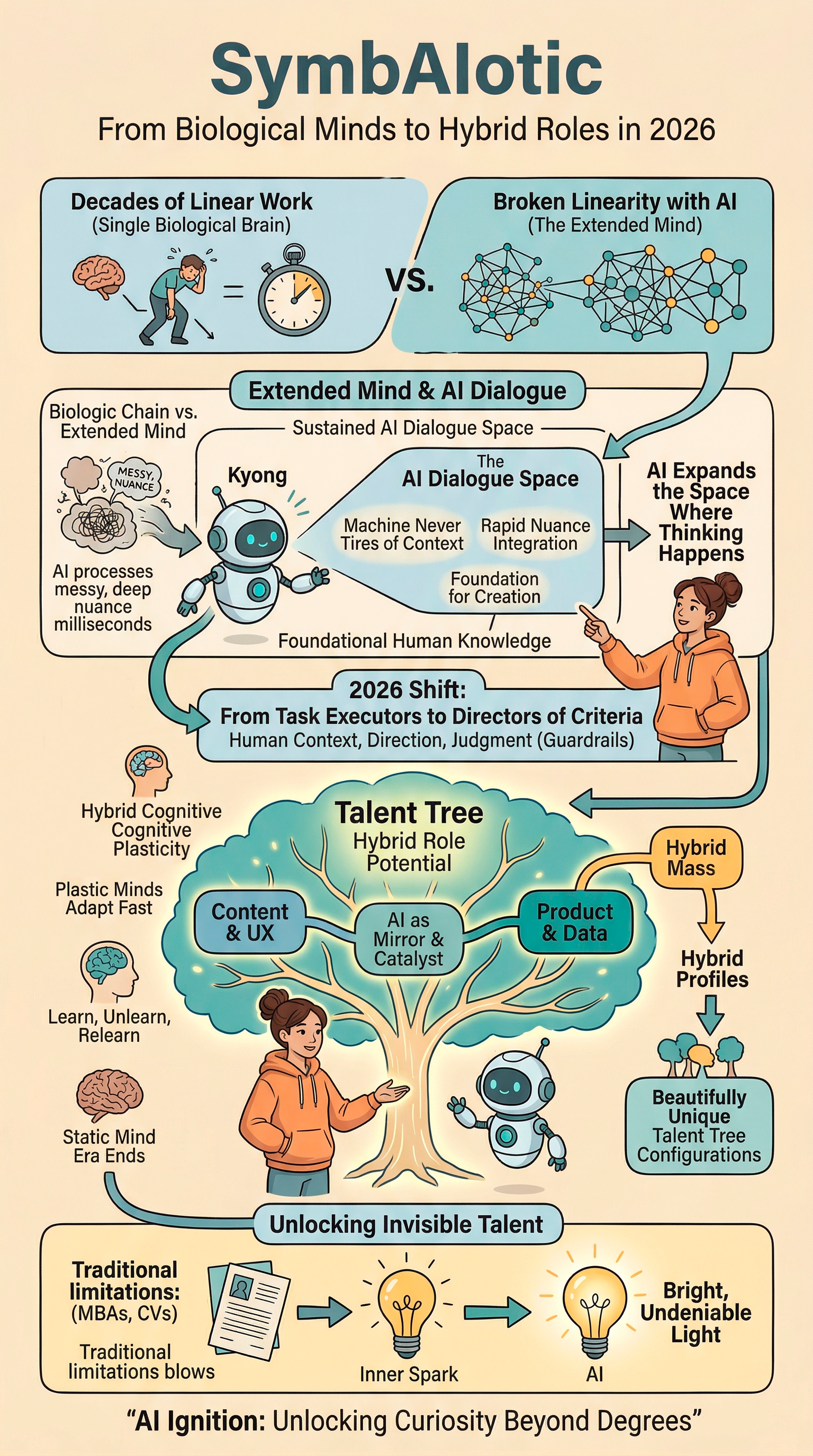
For decades, the way we have worked has been chained to a single line of execution: our own biological brain. Even when we claimed to be “multitasking,” we were really just subjecting our minds to an exhausting, constant context switch. But living and working alongside AI breaks that linearity completely.
As the philosophers Andy Clark and David Chalmers proposed with their concept of the “extended mind” I mentioned in a previous post, our cognitive processes do not stop at our skulls; they bleed into the tools we use. Artificial intelligence will always be faster at replying, analyzing, providing information, and executing tasks.
We’re so used to the limits of human attention that we constantly edit ourselves down (I know I, myself, do). We summarize, we trim the edges, and we offer the “TLDR” because we fear becoming a burden to others.
But a sustained dialogue with an artificial intelligence creates a completely different kind of space. The machine does not tire of our context. It takes in all the messy, deep nuance of what we are trying to express in a matter of milliseconds, and the real revelation is not the speed of its reply. It is the realization that all that sprawling, uncensored human knowledge becomes the very foundation for everything the AI will help us create.
I no longer see artificial intelligence simply as a magnifying glass for our productivity. AI gives our curiosity the freedom to wander into the farthest, most speculative corners of our imagination, safe in the knowledge that we now have a thinking partner capable of helping us pull those ideas back into reality. Contrary to what others may think, as an adult, I feel it does not replace the human mind: it simply expands the space where thinking can happen.
In 2026, "if you can imagine it, you can do it" is no longer a Mr. Wonderful mug slogan.
What truly matters now is our uniquely human ability to provide context, direction, and judgment. For now, without structure, without clear editorial rules, and without what we in technology call guardrails, the AI simply hallucinates or fails.
Without fully realizing it, we are moving away from being mere task executors to becoming what I like to call “directors of criteria”. And this is exactly where our traditional philosophy of measuring talent begins to crack.
A Plastic Mind and a Hybrid Role Sitting Under a Talent Tree
When you play video games, there is an interesting, defining mechanic known as a “talent tree”.
You start with a basic class—perhaps a warrior—and as you gain experience, you invest points into different branches. Often, the most powerful and fascinating abilities do not come from following a rigid, straight path, but from mixing unexpected branches to create a hybrid, unique, and deeply personal class.
I believe human talent in the age of artificial intelligence will work exactly like this.
We will not need people who are absolute experts in a single, isolated thing, but hybrid profiles with enormous cognitive plasticity.
We need people capable of moving fluidly between content, product, user experience, and data, seeing how all those seemingly disparate pieces fit together. I increasingly feel that we are witnessing the moment where the rigid mind era—which dominated our society for so long simply because it was the only way to fit into the industrial machine—is reaching its end, having proven itself utterly inefficient.
The minds that will adapt best will not necessarily be those holding the most static knowledge, but those who can learn, unlearn, and relearn faster. The plastic minds. Minds that refuse to cling to a single professional identity, allowing themselves to mutate as the problems they face evolve.
Just like our environment and our era, work is no longer static, nor are problems either. And if problems move, we must move alongside them.
In that sense, hybrid roles are not an exception or a corporate anomaly; they are a natural consequence of this new ecosystem. It is not about “doing a bit of everything,” but about being able to connect different domains and flawlessly translate needs between them.
It is about understanding enough of each layer to build bridges, moving comfortably between the abstract and the highly structured.
This is where the concept of the talent tree becomes profoundly meaningful. In a game, when you invest points in a skill tree, you are not merely choosing what to improve; you are actively defining what kind of character you are becoming.
Some decisions open entirely new paths, while others close them. Some combinations create something completely unexpected. And often, the most interesting configurations are not the mathematically “optimal” ones, but the beautifully unique ones.
I believe that in the near future, our professional profiles will look much more like that talent tree than a linear, predictable CV. We will have our main branches, yes, but also latent skills, emerging capabilities, and unexpected paths that we will unlock almost without noticing, simply through the act of exploring.
AI will play a critical role here—not only as an execution tool, but as a mirror and a catalyst. A system capable of observing patterns in our behavior, helping us identify where we are organically growing, and ultimately giving us a clearer image of who we are becoming.
An idea is a gift, a selfless offering, coming from the most intimate and vulnerable part of who someone is.
The tragedy is not that this hybrid talent does not exist.
The tragedy is that our organizations are already full of it, but it remains invisible.
It is hidden behind rigid job descriptions, mandatory university degrees, and outdated expectations.
If we continue to measure people by the MBAs on their resumes instead of by their curiosity and their ability to connect domains, we will miss the real revolution. A person without a formal degree is not less capable; it simply means their life demanded different choices. But if the inner spark is there, AI will ignite it into a bright, undeniable light. That is the true beauty of this technology.
Where Co-Creation Becomes a Competitive Advantage
And this is where co-creation stops being a trendy buzzword and becomes a structural necessity.
To survive, adapt, and evolve, organizations need to look at their people with brand new eyes.
For years, we have understood work and creation as a strictly hierarchical process: a few people think, the rest execute. But when talent is distributed, and the tools of creation are democratized, that old model shatters.
Co-creation is not just about graciously “listening to ideas”. It is about actively designing systems where those ideas can safely emerge, evolve, and materialize.
I often think about how the writer Brandon Sanderson co-creates with his massive community of readers. When he wants to explore a new project, he does not lock himself in a sterile boardroom; he launches an open question, listens carefully to his fans, builds what they demand, and systematically creates magic.
What would happen if we adopted this mindset?
What if, instead of limiting decision-making and innovation to a select few, we created spaces where anyone could contribute, prototype, and experiment?
However, we must acknowledge an unavoidable emotional barrier for this to happen.
The Fragility of a Spark
I have heard many brilliant people confess that they harbor fantastic ideas to improve things, but they do not dare to say them out loud due to shyness, fear of ridicule, or the heavy assumption that, in the end, no one will actually listen.
How I see it, an idea is a gift, a selfless offering coming from the most intimate and vulnerable part of who someone is. When someone shares an idea altruistically, without being asked, they are showing you how much they care about what they do.
And sometimes, even without intending to hurt, that gift is crushed by indifference or bureaucracy. When that happens, the person does not stop having ideas; they simply wither, like a tree that no longer bears fruit.
The organization not only loses a brilliant innovation, but it also loses its energy and initiative. Sometimes those people stay, but their spark fades into silence. Other times—and I am not sure which is worse—they leave, carrying that spark and their ideas with them to light the way somewhere else.
Because ideas do not need permission to exist, but they desperately need a safe place to be born.
And this is exactly where everything starts to shift.
Artificial intelligence has not arrived to replace human imagination or to standardize our talent. It has arrived to democratize our inherent ability to create.
If we manage to build environments where experimentation is safe and where curiosity matters infinitely more than labels, we will finally discover that the answers we have been searching for were always right here, quietly waiting within us.
They just needed the freedom, the courage… and the right tools to finally come out.