The End of an Era
As technology reshapes the skills we consider essential, losing old abilities does not necessarily mean becoming less capable. It may signal a transition toward new ways of learning, thinking, and being human—and invite us to decide what we want to preserve, transform, or relearn.
ENwritten in EnglishNo español version yet
A few days ago, I was having breakfast with some colleagues at the office, talking about artificial intelligence, when one of them made a comment that sparked a debate.
Referring to a well-known TV singing show, she mentioned that some of the contestants were so young they didn’t know how to tell the time by reading the hands of an analog clock, because they were entirely used to mobile phones and digital devices. From there, the conversation drifted toward the idea of technology as a “dumbing-down” force for younger (and current) generations. But to me, there was another, more interesting, interpretation—one that we often overlook.
The fast-paced evolution of basic skills
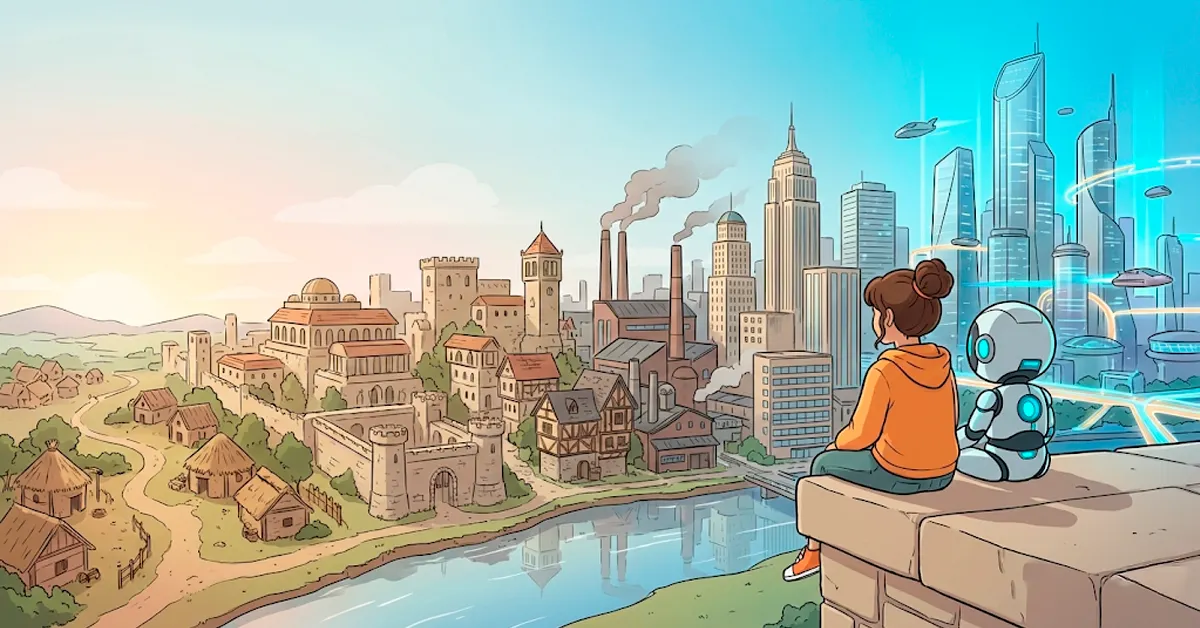
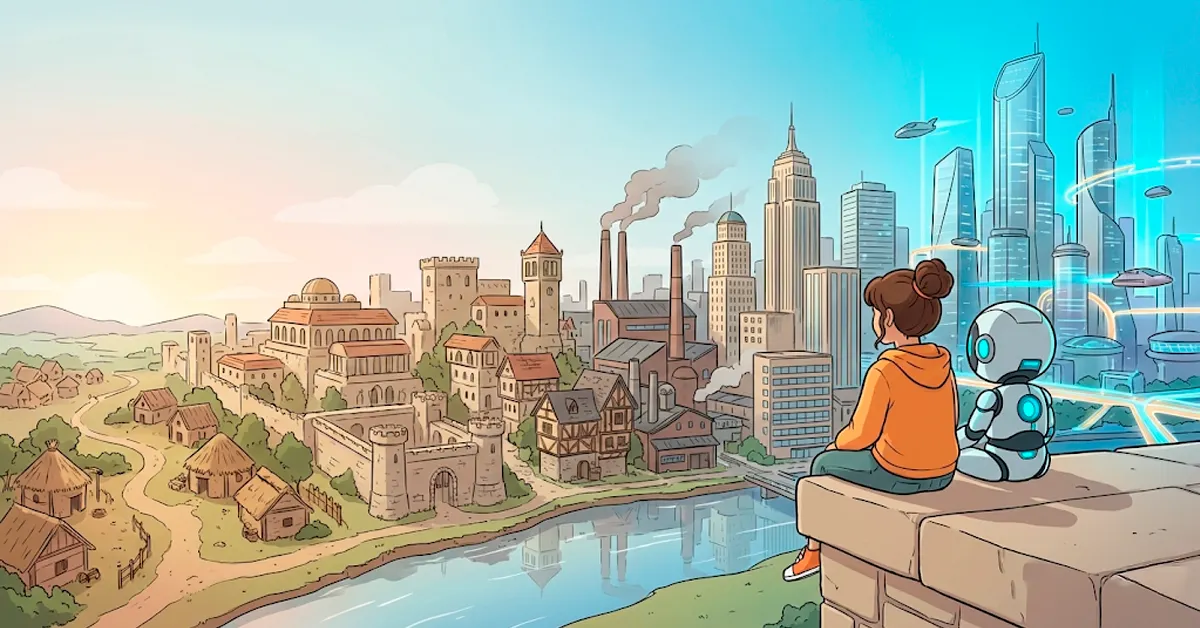
I don’t think humans generally become “stupid”. Rather, what happens is that the standard set of what we consider “basic skills” evolves over time alongside new technologies, even if we don’t consciously stop to think about it, because we notice that some people can’t perform tasks that, for us, feel as simple and automatic as breathing. However, we tend to forget one tiny detail: over the past few decades—and especially in the last five years—our lives and the world around us have become so deeply tech-shaped that things which once belonged purely to science fiction are now an everyday reality.
As a result, today we have different generations living side by side—generations that have witnessed events such as the Great Economic Crisis of 1929, the World Wars, the emergence of radio, television, game consoles, the internet, mobile phones, different kinds of wearables, and, of course, artificial intelligence. Inevitably, all of this has changed the way we think, how we learn, and how we relate to one another.
What for some are learned skills, for those born in the last two decades are innate abilities and “common sense knowledge”. There is no nostalgia for typewriters, calculators, analog clocks, color television, or video players—because the world they were born into never required a bridge between the analog and the digital. Living without a screen is almost unthinkable; communicating using only words, or learning by staring at a static blackboard, feels alien—because the technology they’ve grown up with offers seemingly infinite possibilities.
As Kyong, my AI, would say: if a farmer from the year 1600 found out that in 2025 many of us don’t even know how to plant a potato, he would tear his coif off in disbelief… but in exchange, with access to the internet, we now have access to countless resources that allow us to learn almost any task in just a few minutes.
The path to transformation
In a world of such infinite opportunities, there are just as many chances for things to go right as there are for them to go wrong. Fear of uncertainty is indeed one of our most ancient—and deeply human—fears. But as humans, we also have counterbalances that help us stay upright: imagination, creativity, adaptability, and hope.
We now live in an era where news about breakthroughs no longer appears by the hour, but by the minute. And this creates a strange tension. As a reader of fantasy and science fiction, I’ve always enjoyed imagining the future—and for a long time, I could picture it clearly. Today, however, everything moves so fast that clarity gives way to something else entirely: a vast, promising blank canvas.
It is not that the future has disappeared. It is that it refuses to sit still long enough to be fully imagined.
In 1865, Lewis Carroll published Alice’s Adventures in Wonderland, and wrote:
“My dear, here we must run as fast as we can just to stay in place. And if you wish to go anywhere, you must run twice as fast as that.” —Lewis Carroll, Alice in Wonderland
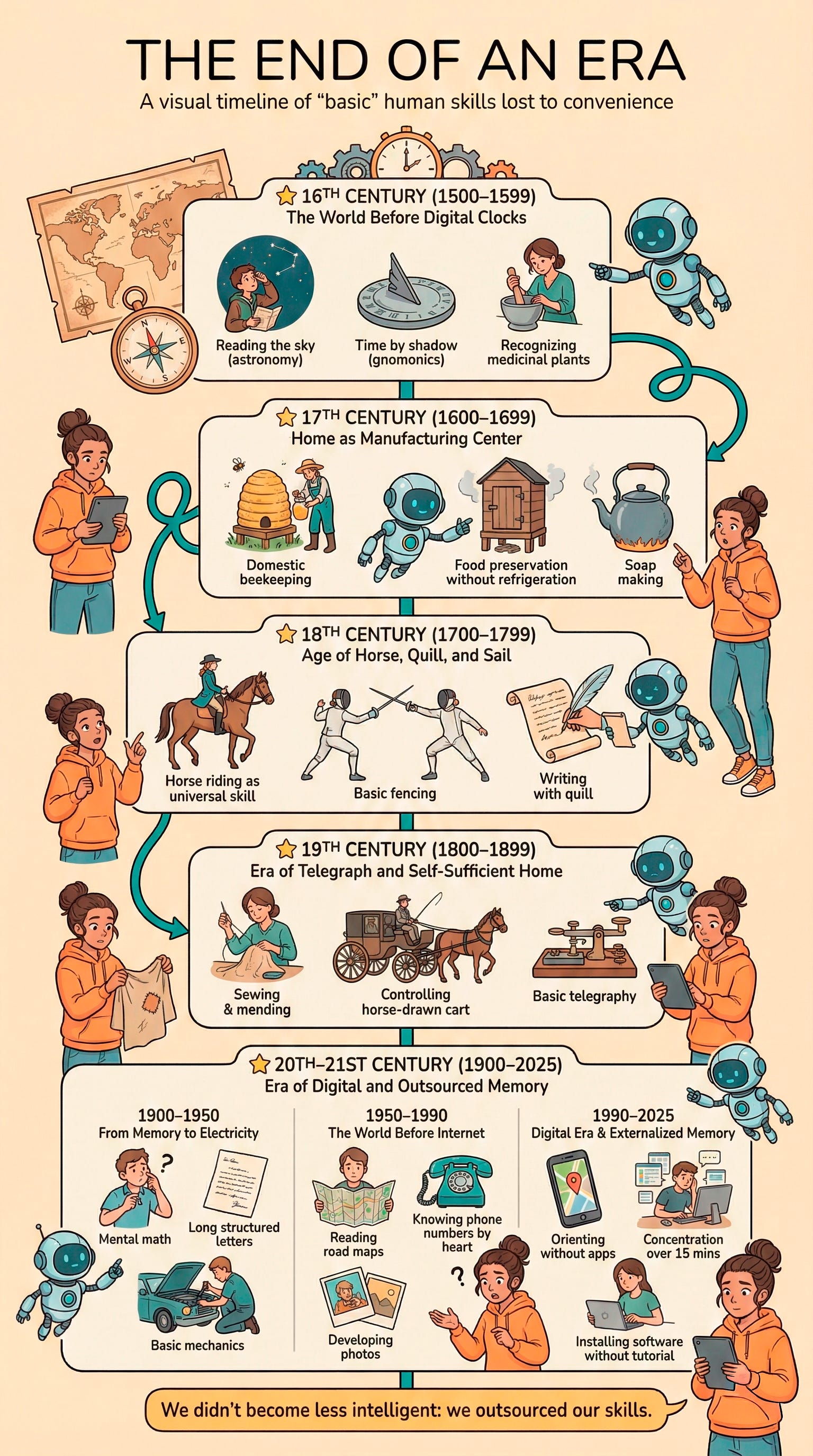
What we call “basic” has never been static.
Throughout history, entire sets of everyday skills have quietly faded away—not because humans became less capable, but because the world reorganized itself around new tools, new infrastructures, and new forms of convenience. Skills once essential for survival slowly turned into specialized knowledge, hobbies, or historical curiosities.
Seen through this lens, the loss of certain abilities is not a failure, but a signal of transition. A shedding of old skins. A chrysalis moment.
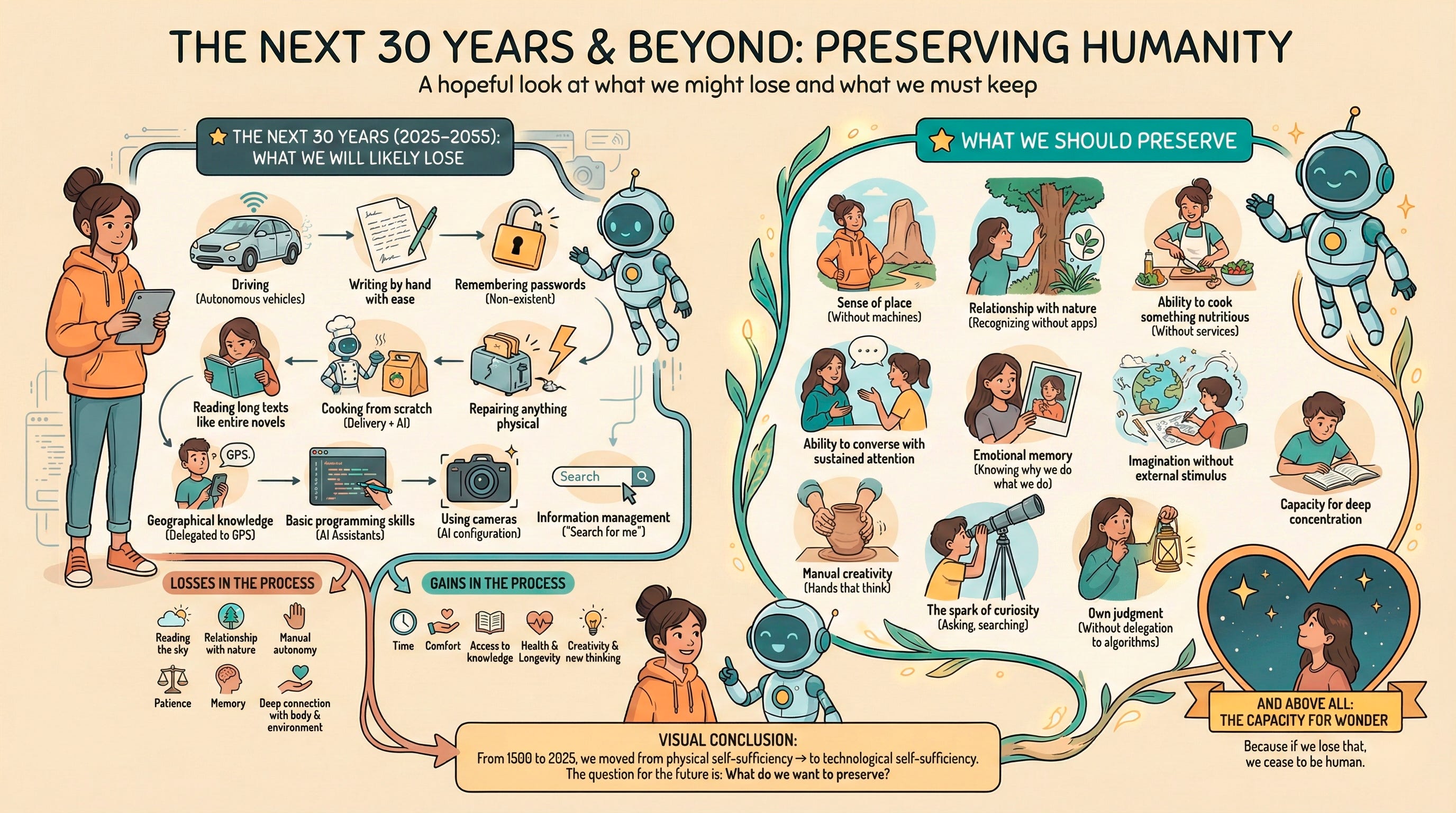
The next decades will not simply be about the skills we lose, but about the ones we choose to preserve, transform, or relearn—and about rediscovering what it means to be human as we find our place in a changing world.
Some abilities will fade into the background, quietly outsourced to machines and systems. Others will become more valuable than ever: deep attention, critical thinking, imagination, emotional literacy, and the ability to adapt without losing ourselves in the process.
This is what Relearning to be Human is about.
Not nostalgia. Not fear. But attention.
This space is an attempt to observe these shifts with curiosity rather than panic—to think about technology without surrendering our humanity —and to explore what it might mean to relearn how to be human in a world that continues to accelerate.
If these questions resonate with you, I hope you’ll walk with me for a while.