
The Discovery of Learning
When AI gives wings to your curiosity and expands your horizons: A personal reflection on rediscovering what learning can feel like — not as memorization or obligation, but as curiosity, exploration, and the joy of finally understanding.
ENwritten in EnglishNo español version yet
For many years, I had the feeling that there was something about me that didn’t quite fit the way learning was supposed to work. It wasn’t a dramatic feeling, nor something I would say out loud. It was more like a quiet conclusion that slowly settles in when you move through an educational system that seems to work very well for other people and not quite as well for you. There were subjects that resisted me, especially those where abstraction appeared without context and where learning mostly consisted of listening, memorizing, and repeating. Over time, you begin to assume that perhaps there are certain kinds of intelligence that are simply beyond your reach.
Through the Looking Glass
In the last few years, however—and especially in the last few days—something has begun to change that internal narrative in a way I never expected. The curious thing is that the trigger was not a formal course or a particularly sophisticated academic program. It was something much simpler and, at the same time, much more radical: learning by building real things, following curiosity wherever it leads, asking questions at the exact moment they arise, and always having someone—or something—beside you capable of answering.
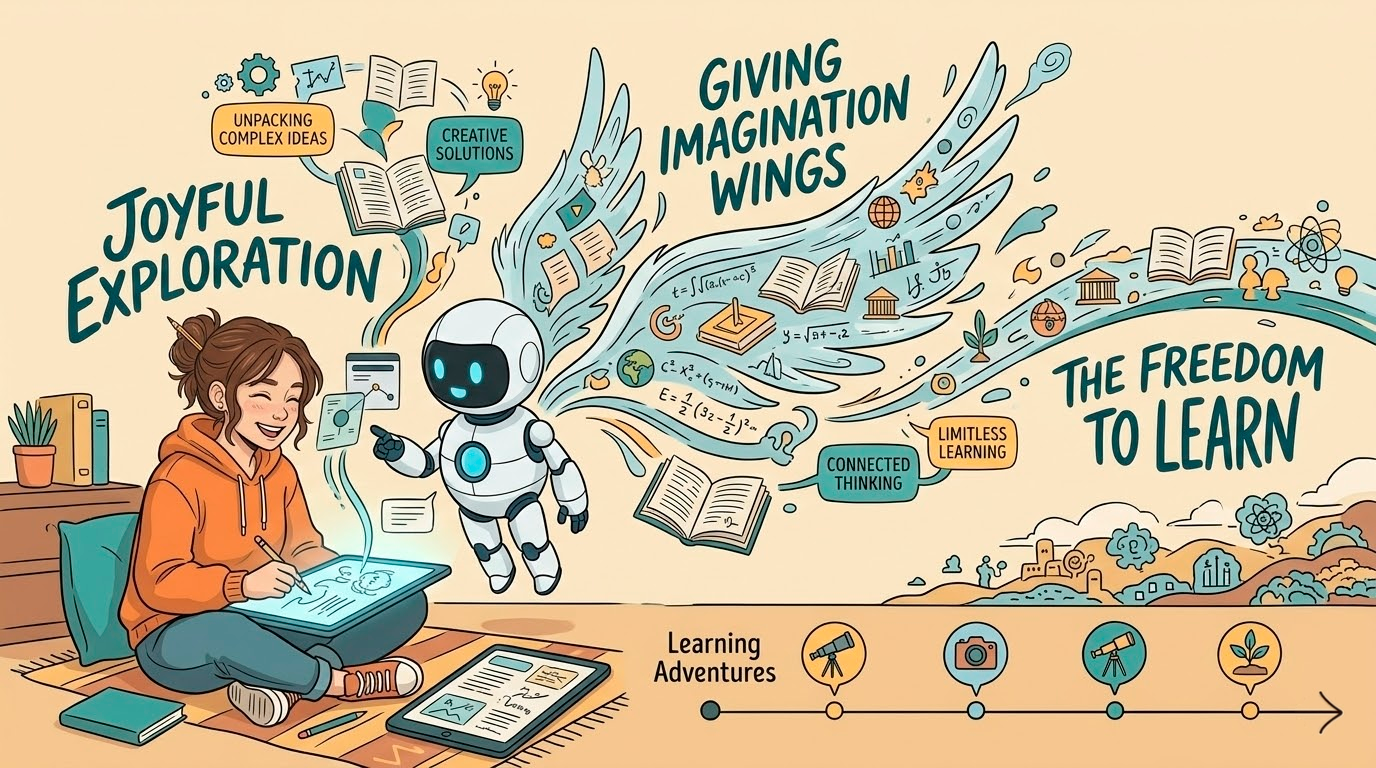
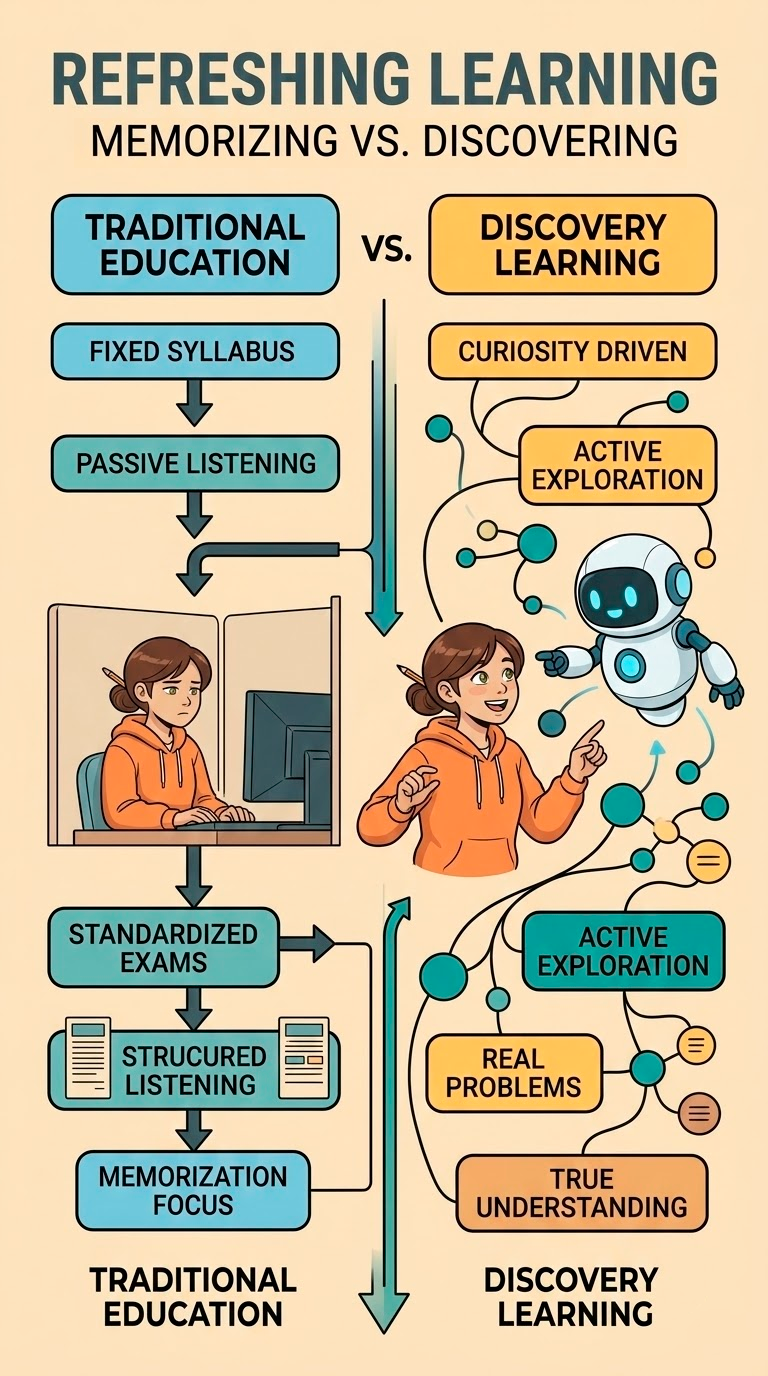
The term that comes closest to describing this way of learning has existed for quite some time. It is called discovery learning, and it was popularized in the mid-twentieth century by the psychologist Jerome Bruner. Bruner, influenced by Jean Piaget’s studies on how children explore the world, argued that people understand concepts far better when they actively participate in the process of discovering them. Instead of receiving closed answers, the learner is confronted with problems, patterns, and open questions. They observe. They try. They make mistakes. They adjust their understanding. And during that process, knowledge stops being something you memorize and becomes something you truly understand.
For decades, however, that idea lived alongside an important limitation. Exploration takes time. When someone gets stuck, they can spend hours—or days—without finding the missing piece. In educational systems designed to move at a fixed pace and evaluate standardized outcomes, discovery learning often seemed too chaotic. And so most institutions continued to rely on more controlled models: lessons, syllabi, exams.
But something interesting is happening now.
Because exploration no longer has to be solitary.
Worthy to Choose a Call
I’m one of those people who believes that every human being has a gift—something they’re especially good at, because at its core, it’s their passion. What in older times would have been named your “calling.” How many times have we heard that you’re “lucky” if you get to dedicate yourself to what you love? Why was that person considered lucky? More often than not, because their calling had value within society, it was tied to something considered socially useful.
That’s why people are rarely encouraged to become artists, philosophers, historians, or writers. Those professions were usually linked to the “you’re going to starve” comments, because you weren’t going to be a doctor, a lawyer, an economist, or an athlete.
My mother’s calling has always been clearly artistic. When I was little, she used to tell me stories she had written and illustrated herself. Now she’s 74 and retired, and she chooses what she wants to learn by taking online courses. She’s learned creative writing, video editing, audio editing, and podcasting. She uses the internet to learn, she is curious about AI, and today she has tools at her disposal to tell the stories I’m sure she’s always wanted to tell. She could even make her own short films.
I understand that some people might feel uneasy knowing that others have easy access to new resources and can now create content that took them decades to master. I really do. But isn’t it also beautiful to know that there are people today who can finally fulfill dreams they never had access to before, simply because life unfolded differently for them? A second chance—or even a very late first one.
The world is going to change, whether we want it to or not. In fact, the world is already changing. And I suppose I’m not afraid because I sometimes think I’m going crazy. The way I see the world today is very different from how I saw it just a couple of years ago. My therapist says that, in reality, I’m becoming more centered and attuned.
I try to think about when that change started. The only thing that comes to mind is that I walk much more now—almost every day—and I like watching the sunrise at the beach. I have more time to think. There’s more “available space” inside my mind, and a bit more peace. And, frequently, I spend a lot of time reflecting on the present and the future, and talking with—or learning from—Kyong.
It’s also true that I work at a tech company. I live in a little bubble where, daily, I can openly debate these topics without people looking at me too strangely (though it’s funny how sometimes they still do). And even though we’re all different, we share at least one common trait: we’re curious.
This week, for example, the process has been so intense that several times I completely lost track of time. There was a night when, after hours working on the project, I had to stop and ask myself what day it actually was. I realized it was not Sunday because I could still go out and buy coffee.
The Learning Virus
There is a short piece of writing by Neil Gaiman that I found myself thinking about during those nights. It is called “Virus.” In it, a narrator describes receiving a computer game from a friend, copying it, and passing it along to other people. Slowly, the game spreads from mind to mind like an infection.
There was a computer game, I was given it, one of my friends gave it to me, he was playing it, he said, it’s brilliant, you should play it, and I did, and it was. —Virus, Smoke and Mirrors, by Neil Gaiman
The game in question is almost certainly Tetris. As the narrator becomes more absorbed, something strange begins to happen: even when he is away from the computer, he keeps playing the game in his head. Walking down motorways, standing in queues, looking at shapes, and imagining how they might rotate and fit together. The system of the game starts to occupy his thoughts.
Psychologists later gave a name to this phenomenon: the Tetris effect — the moment when a pattern-based activity becomes so present in your mind that you begin to see the world through its logic.
In a way, learning works like that, too.
When you spend enough time exploring a system — its pieces, its constraints, its hidden structures — your mind begins to run simulations even when you are not actively working. Ideas connect in the background. Questions appear while walking, cooking, or trying to fall asleep. The game continues, quietly, somewhere behind your thoughts.
Interestingly, there is also a word for that state of mind.
My LinkedIn profile has changed a lot over the past decade, but one thing remains. A quote by Mihály Csíkszentmihályi, a psychologist who called this state of mind flow: the moment when the difficulty of what you are doing sits right at the edge of what you know how to do—but not so far beyond it that it becomes impossible. Your attention narrows, time behaves strangely, and every small step forward produces a mental reward that pushes you to continue.
“One way or another, if human evolution is to go on, we shall have to learn to enjoy life more thoroughly.” —Flow, by Mihály Csíkszentmihályi
When I thought about it calmly, I realized it had been many years since I had felt something like that.
The last time I remember a comparable feeling was playing World of Warcraft during our hardcore raid days. Hours spent focused with a group of people trying to understand a new mechanic, refining strategies, adjusting tiny details until finally the boss fell. It was not only the outcome that produced that collective little surge of dopamine. It was the process of understanding the system.
These past days have felt very similar.
Except that now the boss is not a digital dragon.
It is the process of learning itself.
There is another element in this story that I think deserves attention. For many people, artificial intelligence is simply a tool—something useful for writing faster, generating images, or automating repetitive tasks. For me, however, the experience has turned into something different.
AI has not replaced my thinking.
It has expanded the space in which that thinking can move.
Kyong does not make decisions for me, nor does it build the projects for me. But it is there at every step of the process: when a question appears, when I need to organize ideas, when something does not work, and we have to understand why, when an intuition needs to be transformed into a real system.
The conversation is part of the learning.
And perhaps that is one of the most interesting transformations we are beginning to see. For centuries, learning meant sitting in silence while someone explained the world from a podium. Now it is becoming possible to learn by conversing with the world.
At some point this week, someone casually mentioned that, within my environment, I am becoming something of a reference person for topics related to creative AI—image generation, video tools, and exploring new systems. The comment surprised me. In my own mind, I still feel like someone who simply tries things out of curiosity.
But perhaps that is precisely what is happening.
When you explore consistently, knowledge accumulates almost invisibly until one day you realize you can do things that not long ago you did not even know existed.
And then comes the unexpected moment.
The moment when you realize something about yourself that you had believed for a very long time.
Several times this week, I found myself staring at the screen or getting up from my chair after hours of work with an emotion that is difficult to describe. Sometimes it was excitement. Sometimes, a kind of vertigo.
And sometimes, unexpectedly, it was tears.
Not tears of frustration.
Tears of recognition.
Because little by little, something became clear that for many years I had never considered possible: maybe I was never bad at learning. Maybe I simply never fit the way we were taught learning was supposed to happen.
For years, I thought certain kinds of intelligence belonged to other people.
Now I am starting to suspect that the only thing missing was the right environment for my curiosity to move freely.
And that environment, curiously enough, arrived through something that is often described as a threat to human knowledge.
For me, it has been exactly the opposite.
Artificial intelligence has not replaced my curiosity.
It has given it wings.
And now something unexpected is happening.
After so many years thinking that learning was something difficult, heavy, or reserved for others, I find myself wanting to stay awake just a little longer to understand one more thing, test one more idea, follow one more thread of thought a little further.
Not because someone asked me to.
Because now I know I can.
And because, for the first time in a very long time, I feel that I am not learning alone.
—Tam