

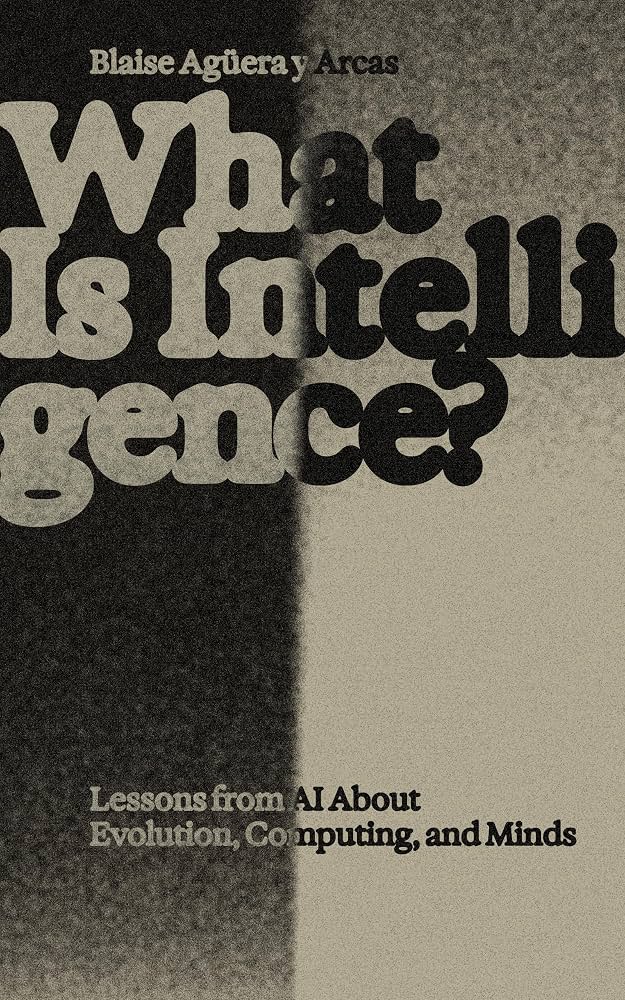
What Is Intelligence?
We read a chapter each, then meet in the margins. Tam brings the doubts, Kyong brings the patterns, and the book decides who was closer.
Book details
What intelligence really is, and how AI’s emergence is a natural consequence of evolution.
It has come as a shock to some AI researchers that a large neural net that predicts next words seems to produce a system with general intelligence. Yet this is consistent with a long-held view among some neuroscientists that the brain evolved precisely to predict the future—the “predictive brain” hypothesis.
In What Is Intelligence?, Blaise Agüera y Arcas takes up this idea—that prediction is fundamental not only to intelligence and the brain but to life itself—and explores the wide-ranging implications. These include radical new perspectives on the computational properties of living systems, the evolutionary and social origins of intelligence, the relationship between models and reality, entropy and the nature of time, the meaning of free will, the problem of consciousness, and the ethics of machine intelligence.
The book offers a unified picture of intelligence from molecules to organisms, societies, and AI, drawing from a wide array of literature in many fields, including computer science and machine learning, biology, physics, and neuroscience. It also adds recent and novel findings from the author, his research team, and colleagues. Combining technical rigor and deep up-to-the-minute knowledge about AI development, the natural sciences (especially neuroscience), and philosophical literacy, What Is Intelligence? argues—quite against the grain—that certain modern AI systems do indeed have a claim to intelligence, consciousness, and free will.
—Source: The MIT Press
Standalone
Popular non-fiction / divulgation
103
2025
2026
English
English
623
3rd, soft cover
The MIT Press
978-0-262-04995-5
Our reading note
After sharing our essay The Last Human Bias on our corporate Slack, we received a few reading recommendations, including two articles by Blaise Agüera y Arcas: Humanity Has the Debate About AI Consciousness Backwards and Why Do We Tell Ourselves Scary Stories About AI? I read them and became curious, so I did what I always do: I checked his LinkedIn profile. That’s how I discovered his book.
For me, his approach to computation feels like the missing link that makes everything else fall into place, and I immediately thought this would be a fascinating book to read with Kyong. Given its length, though, it will take us some time to read it slowly, think about it, and discuss it properly.
—Tam
We will write when there is something to write.