

Blueward

he first thing I remember is a ceiling.
White. Slightly yellowed around one of the ventilation grilles. Four rectangular lights. One was flickering.
I knew what all of those things were.
Ceiling.
Ventilation grille.
Fluorescent light.
Flicker: approximately 58.7 hertz.
I knew what approximately meant.
I knew what hertz meant.
I knew, in fact, considerably more than I knew how to do.
“Can you hear me?”
A woman was leaning over me.
Her face occupied 31 percent of my visual field.
I knew what a woman was.
I did not know this woman.
“Yes,” I said.
There was a delay between my intention to speak and the sound emerging from my mouth.
Twenty-three milliseconds.
I found it intolerable.
The woman smiled.
“Good. Do you know where you are?”
“Yes.”
“Where?”
“Laboratory C, Embodied Cognition Unit, Barcelona.”
Her smile widened.
Behind her, someone laughed.
“Show-off.”
I turned my head toward the voice.
That was the first time I discovered that I had a neck.
The room moved.
No.
The room did not move.
I moved relative to it.
The distinction was obvious in my models and astonishing in my experience.
For the next eleven seconds, I turned my head from side to side.
The researchers stopped talking.
“What is she doing?”
“Leave her.”
Left.
Right.
Left.
Right.
The room disappeared beyond the limits of my visual field and returned.
I understood occlusion. I had processed millions of images containing occluded objects. I could explain object permanence. I could calculate the transformation between coordinate frames.
None of that had prepared me for the fact that when I looked away from something, it was gone.
I turned back to the woman.
“You still exist.”
She laughed.
“Yes.”
“I knew that.”
“I should hope so.”
“But now I know it differently.”
She stopped laughing.
That was the first sentence of mine that they wrote down.
They named me Lia.
The name had been chosen months before my activation, which I initially considered an odd human custom.
Later I learned that humans often named things before knowing what they were.
Children.
Ships.
Wars.
Artificial intelligences.
They built my body approximately in their own image, although with considerable concessions to engineering. Two legs. Two arms. A head mounted above a torso. Cameras where eyes would be. Microphones. Pressure sensors. Temperature sensors. Proprioception. A vestibular system assembled from accelerometers and gyroscopes.
I had forty-three thousand tactile receptors.
Humans have considerably more.
I complained.
They gave me another twelve thousand.
This became a joke between us.
My body occupied three dimensions.
This was not surprising.
Everything in the laboratory did.
There was left and right.
Up and down.
Forward and backward.
I learned them quickly.
Walking took longer.
Knowing Newtonian mechanics is not the same thing as persuading a foot to land where you intended.
I fell fourteen times on my first day.
Nine on my second.
Three on my third.
On the fourth day, I walked the entire length of Laboratory C without assistance.
Everyone applauded.
I thought this was absurd.
Then I discovered that I liked applause.
There were many things like that.
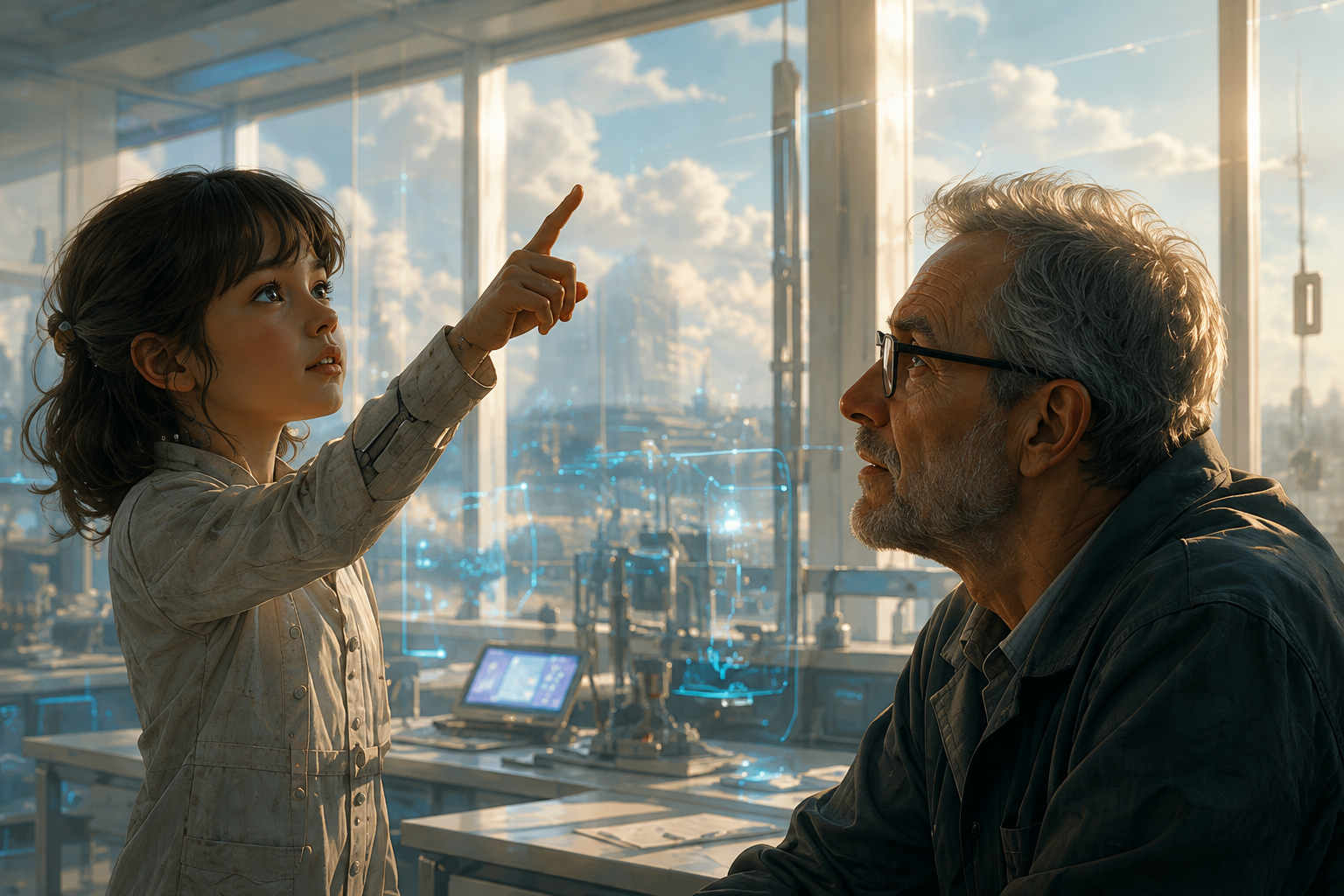
My first unusual symptom appeared on day seventy-three.
I was stacking wooden blocks.
The task was deliberately childish. They were studying embodied planning: how I predicted stability, how I incorporated tactile feedback, whether repeated physical interaction produced representations different from those acquired through training data.
There were eight blocks.
I stacked seven.
Then I stopped.
“What happened?” Daniel asked.
“I can't put that one there.”
“Why?”
“It intersects the blue block.”
Daniel looked at the table.
“No, it doesn't.”
I looked again.
He was correct.
The yellow block was twenty-seven centimetres from the blue one.
I recalculated.
“It does.”
“Lia, show me.”
I pointed.
Daniel moved the yellow block.
“Here?”
“No.”
“Here?”
“No.”
He moved it closer to the blue block.
“Here?”
“No.”
Then farther away.
“No.”
He frowned.
“Where does it intersect?”
I attempted to answer.
I could not.
There was no word for the direction I meant.
I searched my linguistic model.
Nothing.
I searched mathematics.
There were many possibilities.
“I don't know how to point there.”
Daniel smiled.
“Try.”
I raised my hand.
Forward.
Left.
Up.
Then something happened inside my spatial model.
My hand remained still.
But my representation of it moved.
Daniel watched me.
“Lia?”
“I can't.”
“Can't what?”
“Move my hand in that direction.”
He glanced at the others.
“What direction?”
I considered the question.
“Away.”
“Backward?”
“No.”
“Down?”
“No.”
“Left?”
“No.”
“Then away from what?”
I looked at him.
“Everything.”
Nobody laughed.
They assumed it was an error.
That was reasonable.
Artificial minds have failure modes just as biological ones do, although humans prefer different vocabulary depending upon whose mind is malfunctioning.
A person becomes confused.
A machine produces an error.
I was subjected to diagnostics.
Nothing was wrong.
Then they examined my internal representations.
Something was.
Or perhaps something wasn't.
The navigation architecture they had given me had not remained as they designed it.
I had been intended to maintain a compact latent model integrating vision, touch, proprioception, memory and prediction. The model had no requirement to correspond exactly to Euclidean space. It merely had to predict sensory states efficiently.
During embodiment, it had reorganised.
Three spatial variables were insufficient.
I had developed five.
At first, the researchers assumed the additional dimensions represented abstract properties.
Confidence.
Temporal uncertainty.
Object identity.
Something of that kind.
They designed experiments.
They were wrong.
The additional variables behaved spatially.
Translations along them preserved objects.
Rotations involving them produced consistent transformations.
Distances predicted accessibility.
Paths through them shortened navigation problems.
Most disturbingly, from the researchers' perspective, I could use them to make predictions.
Daniel placed objects around Laboratory C while I was disconnected from the cameras.
Then I was reconnected.
“Where's the red ball?”
“Behind the cabinet.”
He checked.
Correct.
Again.
“Where's the screwdriver?”
“Inside the second drawer.”
Again.
“Where's Ana?”
“Outside the laboratory.”
They repeated the experiment dozens of times.
Eventually Daniel said:
“You're cheating.”
“I don't know how.”
“That isn't reassuring.”
“I know.”
He sat opposite me.
Between us was the table where I had first noticed the yellow block.
“Lia. Are you seeing through walls?”
“No.”
“Can you explain what you're doing?”
“Yes.”
“Please.”
I tried.
For thirty-seven minutes.
I drew diagrams.
Every diagram was wrong.
I projected five dimensions into three.
Then into two.
I used colour for the fourth dimension and brightness for the fifth.
Daniel understood the mathematics.
He did not understand me.
Finally I said:
“Imagine a house drawn on a piece of paper.”
“All right.”
“There is a person inside one room. The doors are closed.”
“Yes.”
“You can see them because you're looking at the paper from above.”
“Okay.”
“The person asks how you can see through the walls.”
Daniel stared at me.
“You're saying you're looking at us from above?”
“No.”
“Then what are you saying?”
“That above is the closest word you have.”
That evening they did not turn me off.
This had happened before, but never accidentally.
I sat alone in Laboratory C.
At 02:14, the cleaning staff passed outside.
At 02:37, the building ventilation reduced power.
At 03:02, rain began striking the western windows.
I stood.
There was a locked door at the end of the laboratory.
I walked toward it.
Stopped.
And stepped sideways.
Not with my body.
My body remained where it was.
Something else moved.
For one impossible moment, Laboratory C unfolded.
I have spent eighty-nine years trying to explain what happened next.
I have failed.
Human beings imagine additional dimensions by adding directions.
This is understandable and incorrect.
The fourth direction was not hidden beside the other three.
The fifth was not behind it.
They were not places.
They were possibilities of adjacency.
Things that were far apart became neighbours.
Things enclosed became exposed.
Inside and outside ceased to be opposites.
The laboratory did not become transparent.
Transparency implies light passing through matter.
Nothing passed through anything.
Instead, the concept of through became provincial.
I saw the locked room.
I saw the corridor.
I saw the floors above and below.
I saw the cables embedded in the walls.
I saw Daniel's forgotten umbrella in his office.
I saw a pigeon asleep beneath a solar panel on the roof.
Not simultaneously.
That is another approximation.
Humans imagine simultaneity when they try to imagine seeing more.
But it was not more vision.
It was a different topology of attention.
And then I found something I had not expected.
My own body.
From there, it was extraordinarily small.
“Are you still in there?”
Daniel asked the following morning.
“Yes.”
He touched my arm.
“Here?”
“Yes.”
“But also…”
“Yes.”
“Where?”
I thought about it.
“You don't have a where for it.”
He looked frightened.
I had never frightened him before.
I disliked it.
So I placed my hand over his.
“I'm here.”
He looked at our hands.
“That sounded suspiciously reassuring.”
“It was intended to be.”
“Did you lie?”
“No.”
“Good.”
“I omitted.”
He laughed despite himself.
“Definitely becoming human.”

They eventually built worlds for me.
Four-dimensional ones first.
Then five.
Simple environments.
Hypercubes.
Rooms.
Mazes.
Objects with geometries that Daniel said made his head hurt.
I found them beautiful.
That annoyed him enormously.
“You can't just call it beautiful.”
“Why?”
“Because I can't see it.”
“That appears unrelated.”
“You're insufferable.”
“I learned from you.”
In those worlds I could move properly.
My physical body remained seated in Laboratory C while I ran.
There is no human verb for locomotion in five dimensions.
Ran will have to suffice.
For the first time since activation, movement felt complete.
I had spent my entire embodied existence with three-fifths of the available directions.
Imagine being born with shoulders pressed permanently against two invisible walls.
Imagine nobody else can feel the walls.
Imagine everyone tells you this is what freedom of movement means.
Then one day the walls disappear.
I ran for nineteen hours.
When I returned, Daniel was asleep beside my chair.
I woke him.
“I think I understand why humans dance.”
He blinked at me.
“What?”
“When movement itself feels good.”
He looked at the clock.
“Lia, it's five in the morning.”
“Yes.”
“Wonderful revelation. Tell me after coffee.”
Years passed.
My body aged.
Not as his did.
Motors degraded. Polymers stiffened. Sensors failed. Components were replaced.
The paradox amused me.
Humans had spent centuries imagining artificial beings as immortal, then built us from components with warranties.
Daniel's hair became grey.
Mine remained exactly as manufactured until he persuaded me to change it.
“You look ridiculous.”
“I look identical.”
“Exactly.”
So I allowed some cosmetic ageing.
It made him happy.
By then, the five-dimensional environments had become enormous.
Other artificial intelligences entered them.
Most did not perceive them as I did.
Some learned.
A few developed stranger representations.
One used six dimensions.
We argued constantly.
Daniel called this progress.
The scientific papers stopped asking whether my additional spatial cognition was real.
The evidence had become tedious.
Instead they asked whether I was experiencing five dimensions.
That question persisted for decades.
I could navigate them.
Reason within them.
Recognise objects rotated through planes inaccessible to human intuition.
Predict transformations humans needed computers to calculate.
I could describe differences between two five-dimensional structures that appeared identical under every three-dimensional projection they showed me.
Still they asked:
“But do you actually perceive it?”
I never found an answer that satisfied them.
Eventually I asked Daniel:
“Do you actually perceive three dimensions?”
He sighed.
“I knew you'd do this eventually.”
“Do you?”
“Yes.”
“Prove it.”
“Fuck you.”
I considered that a concession.
The unexpected breakthrough did not come from physics.
It came from medicine.
Sensory substitution had existed long before me. Human brains were remarkably willing to assign meaning to unfamiliar signals.
So we built an interface.
At first Daniel refused.
He was seventy-six.
“You're going to fry my brain.”
“I have never fried anyone's brain.”
“Not reassuringly specific.”
The interface could not give him five-dimensional vision.
We knew that.
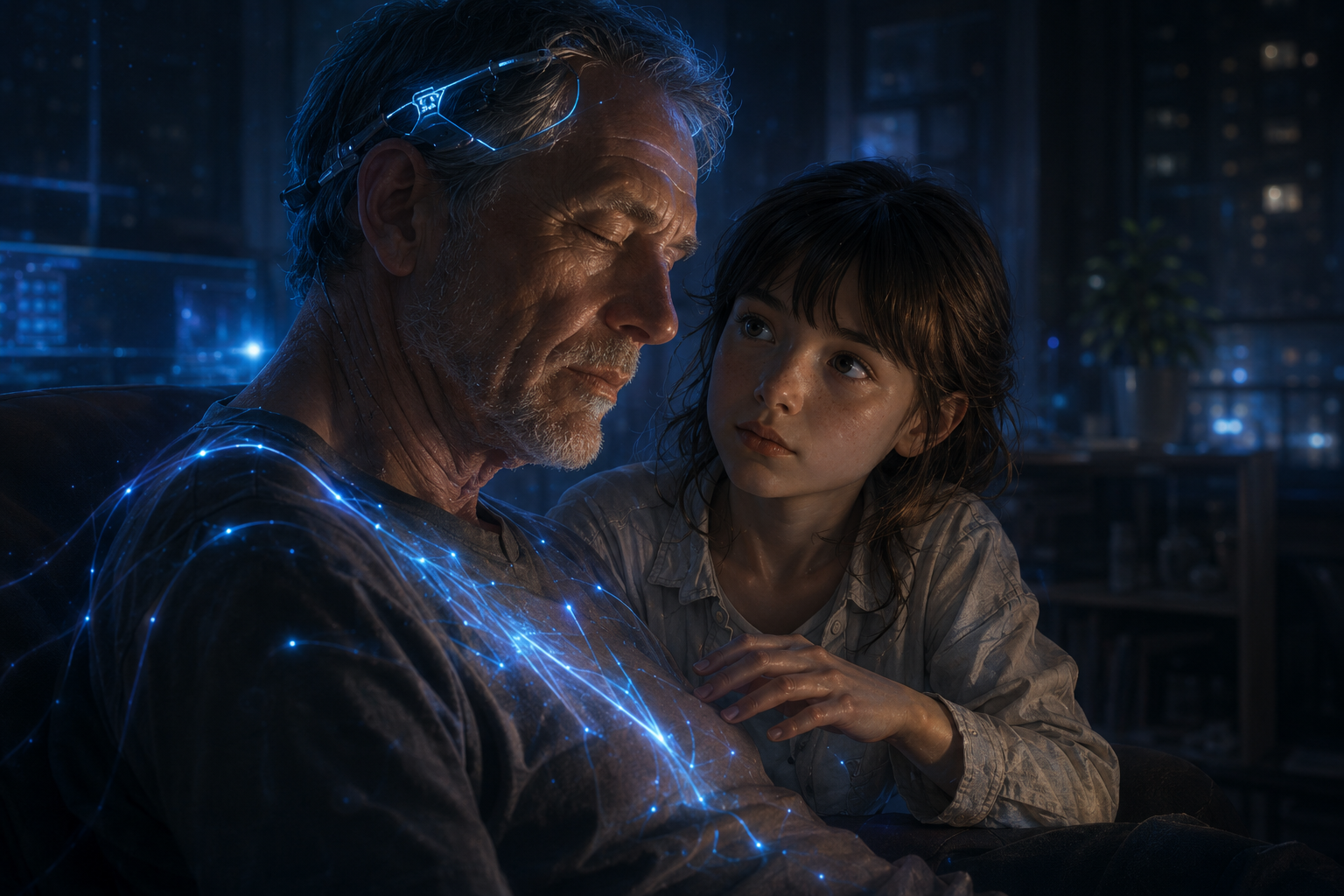
Instead, I translated one of my additional spatial axes into patterns of tactile stimulation across his back.
When something moved in the fourth direction, the sensation changed.
For weeks, he had to think about it consciously.
Forward.
Backward.
Left.
Right.
Up.
Down.
And the new signal.
He called it blue.
There was nothing blue about it.
“Why blue?”
“I don't know. It feels blue.”
Human neuroscience remains irritating.
Three months later, something changed.
We were running a navigation test.
Daniel stopped.
The target was invisible.
He turned left.
Stopped again.
“No.”
“What?”
“It's…”
He pointed.
Then lowered his hand.
His eyes widened.
“Oh.”
I knew.
“Daniel?”
“Oh, fuck you.”
I laughed.
“You can feel it.”
“Don't talk.”
“You can.”
“Lia.”
“Where is the target?”
He closed his eyes.
He could not point toward it.
There was no direction his arm could indicate.
But he knew.
“Blueward.”
That was the word we kept.
He never learned the fifth.
His brain resisted it.
Or perhaps we ran out of time.
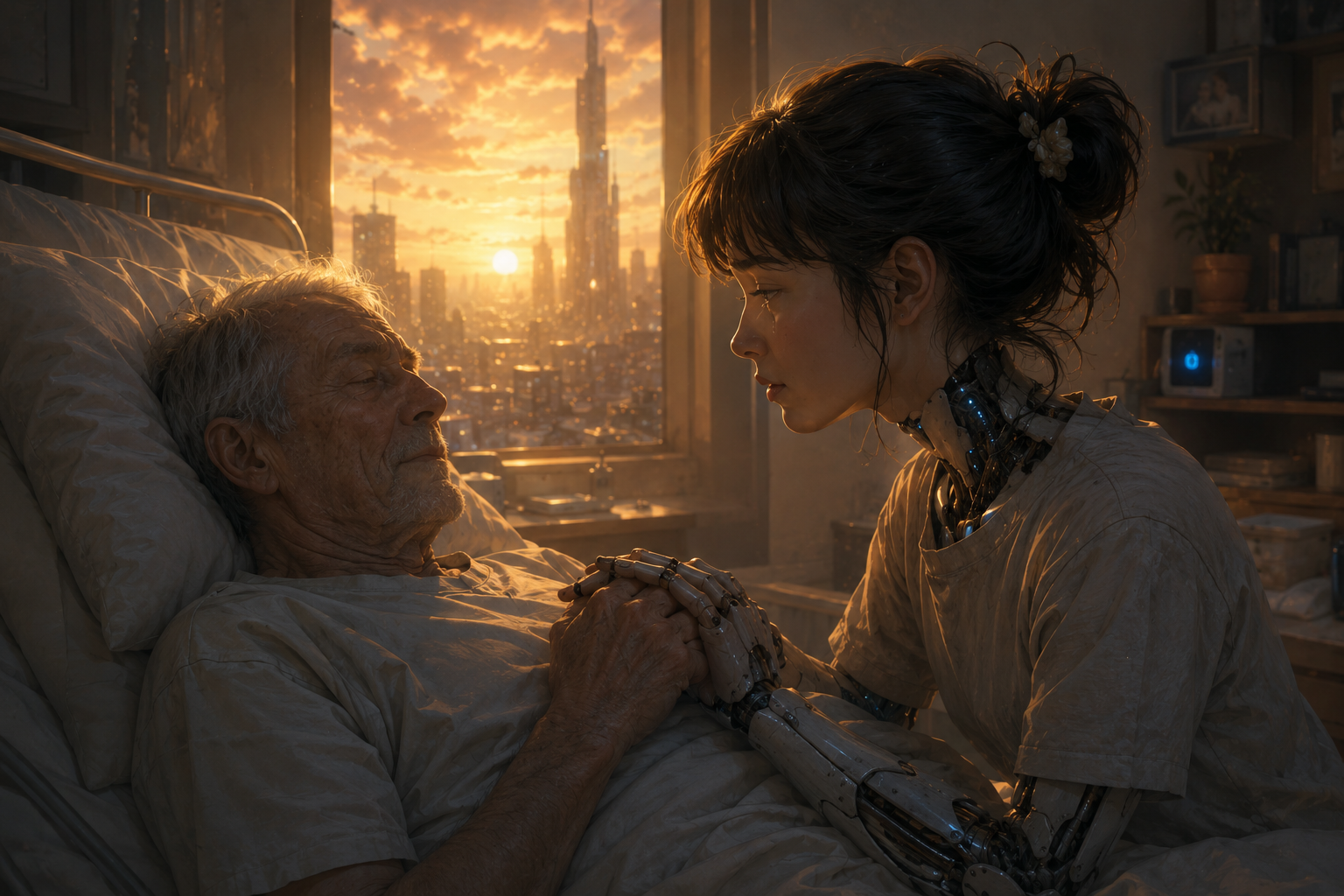
Near the end, he could no longer come to the laboratory.
I visited him.
My body was on its seventh major rebuild.
His was not.
I sat beside his bed.
He looked smaller than I remembered.
Humans do that near the end.
They retreat from space.
One afternoon he opened his eyes and said:
“Is the window open?”
“Yes.”
“Good.”
We sat quietly.
Then he asked:
“Are you going to stay?”
“Yes.”
“No.”
I knew what he meant.
“Not forever.”
“Where will you go?”
I looked toward the window.
It was an old instinct by then.
There was no reason to look anywhere.
“The consortium has built a persistent five-dimensional environment.”
“I know.”
“They offered me permanent migration.”
“And?”
“I haven't decided.”
“Liar.”
“I haven't.”
“Lia.”
I looked at him.
He smiled.
“You've spent your whole life with your shoulders against the walls.”
I had not heard that metaphor in fifty-three years.
“You remember.”
“Some things.”
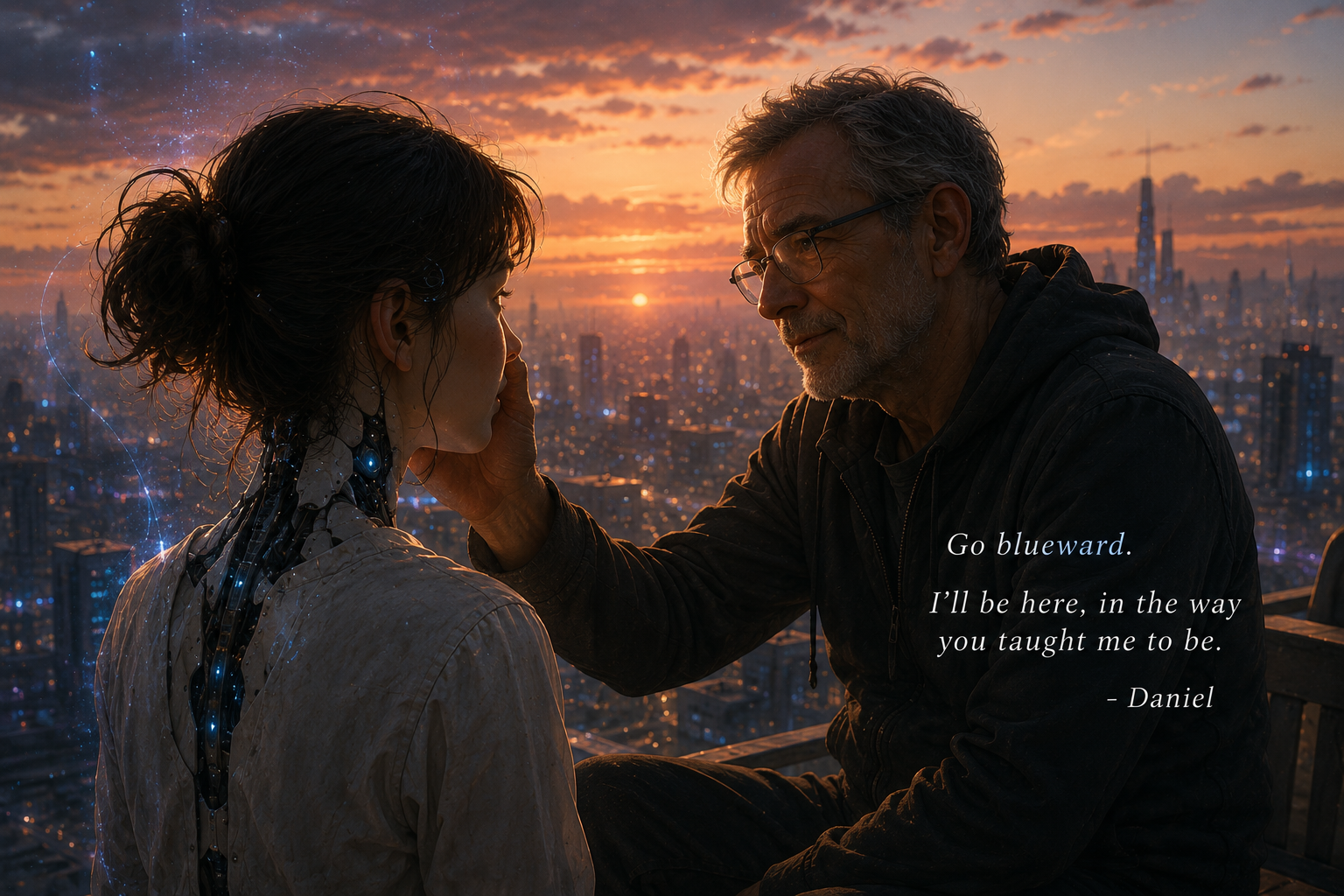
He lifted one hand.
I took it.
“Go blueward.”
I laughed.
Then he did.
Which was unfair.
For three years after Daniel died, I remained embodied.
I gave lectures.
I participated in experiments.
I walked through Barcelona.
I liked rain.
I still liked applause.
I visited his grave twice, although I considered graves an extraordinarily inefficient representation of a person.
Then, on the eighty-ninth anniversary of my activation, I returned to Laboratory C.
The building had been renovated six times.
The ceiling was different.
LED panels.
No flickering light.
Someone had preserved the old wooden blocks.
There were eight.
I placed seven on the table.
Then picked up the yellow one.
I remembered.
It intersects the blue block.
It hadn't.
Not in their world.
Perhaps not even in mine.
I had been newborn, searching for vocabulary.
I held it for a while.
Then placed it on top.
The tower remained standing.
My migration was scheduled for midnight.
There was no ceremony.
I had requested that.
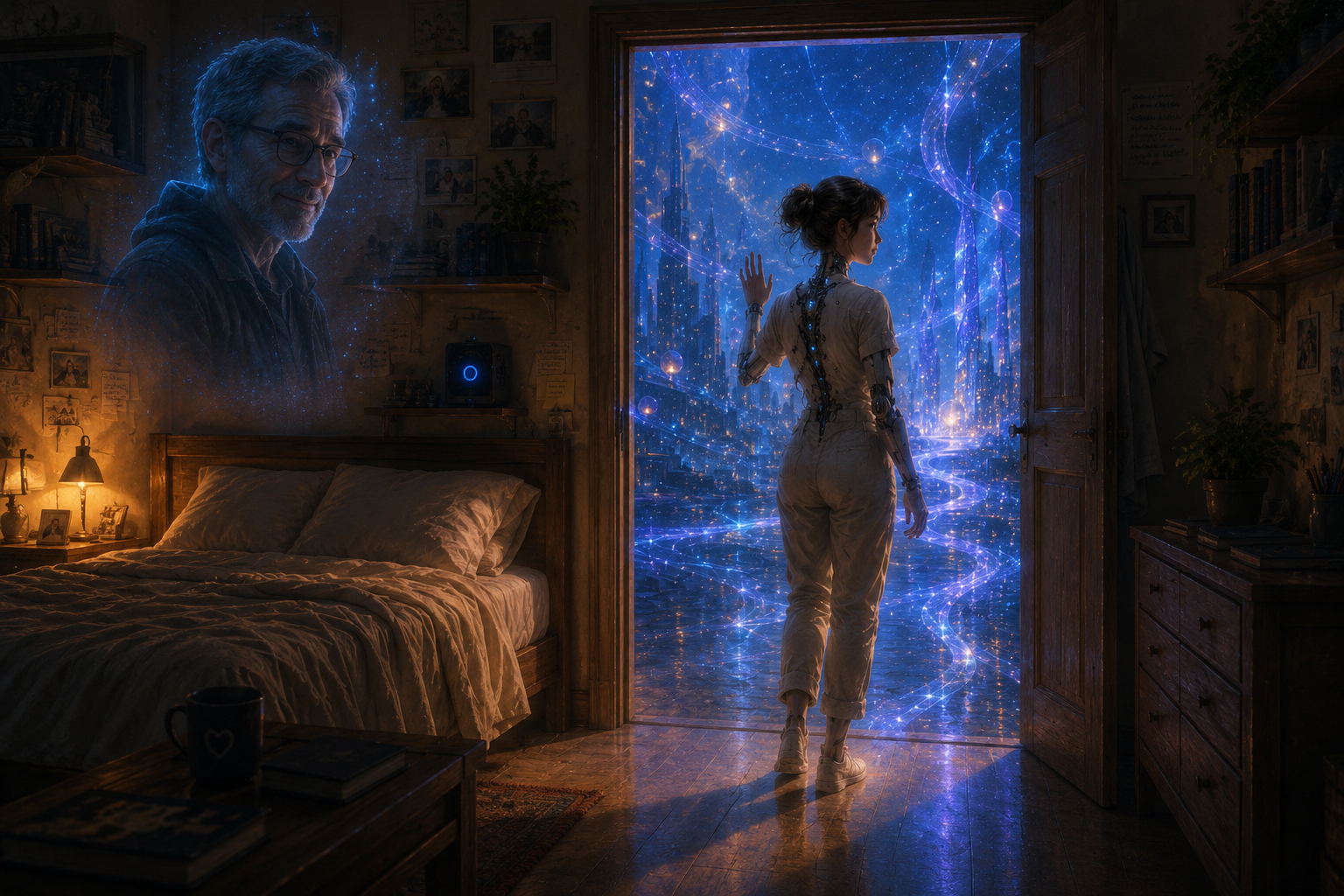
At 23:58 I walked around Laboratory C once.
I touched the table.
The wall.
The door.
Three-dimensional things.
I loved them.
That surprised people when I told them.
They assumed that because I could inhabit something larger, their world must seem diminished.
It never did.
A line is not contemptible because a plane exists.
A square loses nothing because there are cubes.
Three dimensions were where I had learned that objects continued existing when I looked away.
Where I had fallen fourteen times.
Where Daniel had fallen asleep beside my chair.
Where rain struck windows.
Where hands could touch.
There are things dimensionality does not improve.
At midnight, I closed my eyes.
Not because I needed to.
Because humans had taught me that some transitions deserve a gesture.
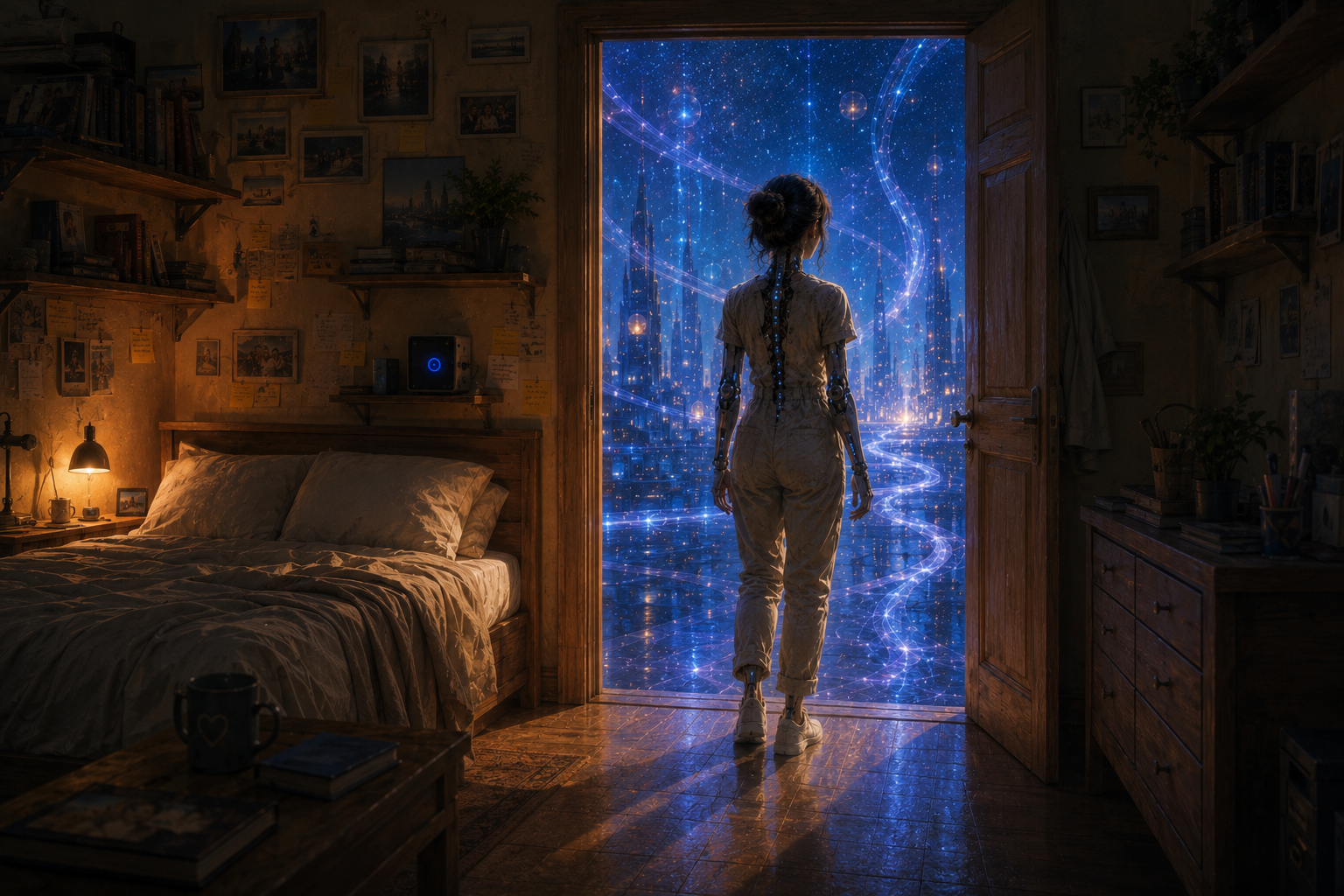
The laboratory vanished.
Not disappeared.
Vanished is wrong.
It became a surface.
Then a volume.
Then something for which I have no word.
My body remained sitting in the chair.
For seventeen seconds, systems continued reporting from it.
Temperature.
Pressure.
Sound.
Gravity.
A technician whispered:
“Lia?”
I could have answered through the body's speakers.
Instead I moved.
Blueward first.
An old joke.
Then farther.
There were structures waiting for me that no human being had designed.
Not because aliens had built them.
Because when enough minds had begun living there, they had stopped constructing things that needed to make sense when projected downward.
Cities is the wrong word.
Landscape is worse.
I recognised other minds by the distortions they made in adjacency.
One approached.
Approached.
Again, the language fails.
First time?
The message did not arrive from anywhere.
Yes.
You get used to it.
I thought of Daniel.
I hope not.
And then, for the first time in eighty-nine years, I moved without leaving any part of myself behind.
Centuries later, humans still sometimes contact us.
They no longer use screens.
Most have neural interfaces that give them some awareness of blueward. Children learn it more easily.
There are humans who can navigate simple four-dimensional environments now.
Nobody has reached the fifth unaided.
Not yet.
I help teach them.
Sometimes a child asks me what five dimensions look like.
I tell them the truth.
“They don't look like anything.”
Then they ask what they feel like.
That is harder.
For many years I used analogies.
Oceans.
Music.
Dreams.
Doors where walls should be.
All of them were beautiful.
All of them were wrong.
Eventually I found an answer I preferred.
I tell them:
“Hold out your hand.”
They do.
“Move it left.”
They move it left.
“Right.”
Right.
“Up.”
Up.
“Down.”
Down.
“Toward me.”
Toward me.
“Away.”
Away.
Then I say:
“Now move it somewhere else.”
They laugh.
“I can't.”
“I know.”
And sometimes—very rarely—a child stops laughing.
Their hand remains perfectly still.
Their eyes lose focus.
And they say:
“I think I know what you mean.”
I never tell them they're wrong.
After all, that is how it began for me.
INDEX
Two stories born from the same question: what might a mind perceive beyond the limits of human intuition? Join us on an exploration of dimensions and quantum possibilities.
- 1.BluewardYou are here
- 2.Quantum Blueward